
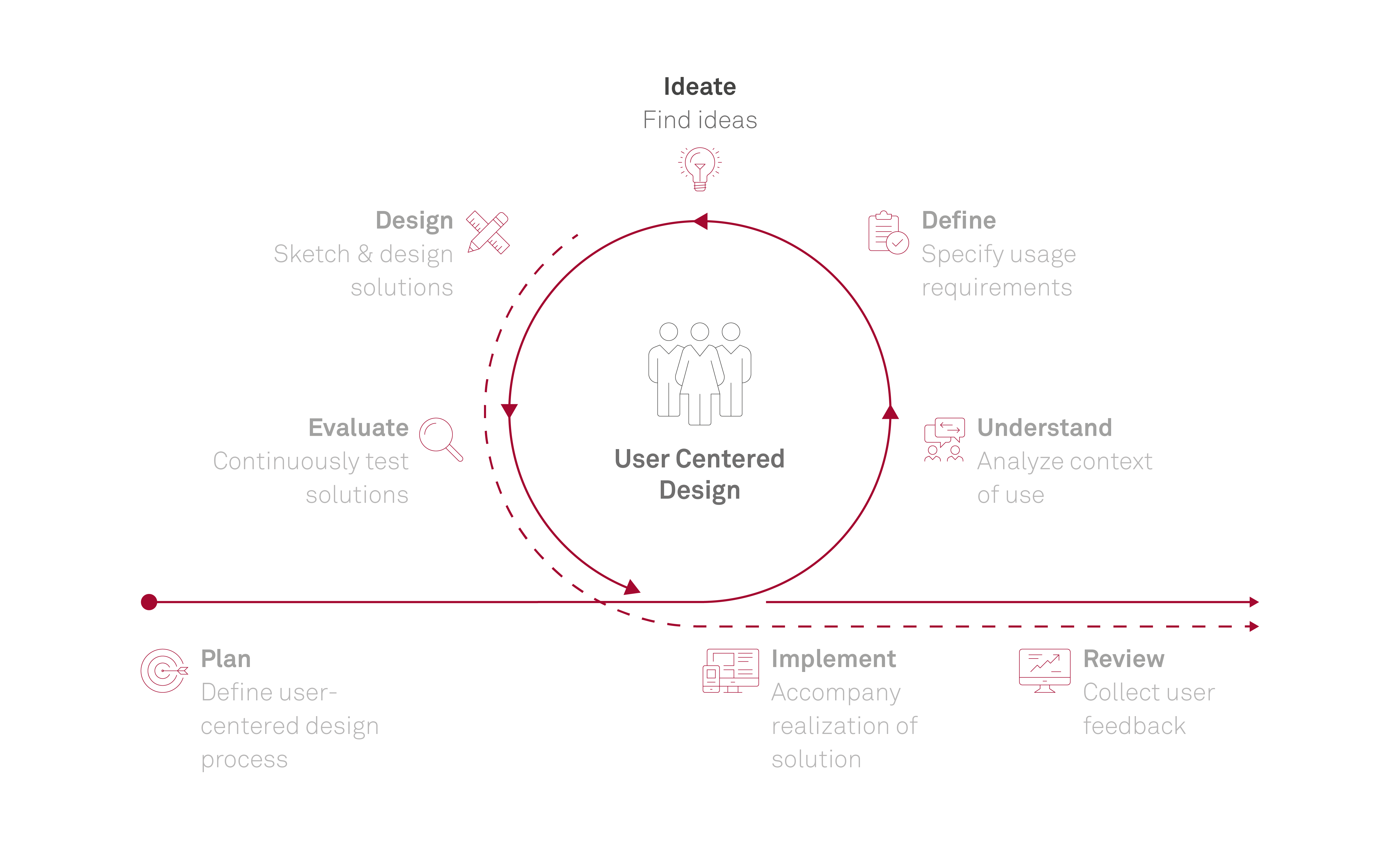
# Ideate
Generate suitable solutions by using creativity methods.
# Summary
In this phase, the user requirements from the Define phase are converted into solution ideas. Creative methods are used for this purpose. At the transition to the next phase (Design), individual ideas are prototyped and evaluated to find the most suitable design solution. This is then detailed in the Design phase.
TL;DR - AI in this phase: In ideation, AI opens breadth. It helps prepare workshops, generates many idea variants in parallel, structures ideas, and provides evaluation impulses. However, it does not replace collaborative team reflection and does not create fundamentally new ideas; selection, prioritisation and connection to the real user problem remain human tasks.
# Result
An appropriate solution to the problem and the requirements of the users.
# Questions to be answered in this phase
- How do we solve the problem?
# Benefits & use cases of AI
# Preparing workshops and phase transitions
- AI suggests workshop flows, agenda variants, moderation guides and preparatory materials tailored to the goal, participant group and available time.
- It reveals thinking and process gaps by critically reviewing flows, workflows or workshop plans, identifying missing steps and addressing blind spots.
- It translates insights from the Define phase into initial solution approaches by deriving ideas from pain points, requirements or hypotheses, making the transition from problem space to solution space easier.
# Generating ideas exploratively
- AI acts as an exploratory sparring partner, suggests initial ideas, creates variants and intentionally generates many alternatives ("variant explosion"), including unusual combinations beyond obvious thinking patterns.
- Its particular value emerges when AI is not optimised for one direction, but opens several solution directions in parallel and thereby fosters inspiration and breadth.
# Structuring ideas and challenging them critically
- AI provides initial guidance for classification and pre-selection by comparing ideas, identifying similarities, or indicating possible relevance, feasibility or redundancy.
- It clusters proposals, groups them by theme and makes relationships between different solution approaches visible, which improves orientation in large idea sets.
- AI makes ideas easier to understand by structuring, condensing or visualising them, which supports discussion and participation because ideas become more quickly accessible and comparable.
- It helps challenge one's own perspective systematically, explore alternative framings and mark contradictions or unexpected relationships between assumptions, requirements and ideas.
# Evaluating, framing and iterating
- AI introduces different perspectives into evaluation, for example through role play (stakeholder perspectives, "Six Thinking Hats") or by contrasting different viewpoints.
- As a neutral third party, AI can suggest evaluation criteria and indicate blind spots, provided the criteria are clearly anchored in context and explicitly formulated.
- AI supports iterative development of ideas by combining, refining and adapting them based on feedback or new insights.
- It helps with contextualisation by relating solution approaches to user needs, business goals or technical constraints, making relevance and viability more visible.
# Risks of using AI
# Speed overwhelms reflection and decisions
- Rapid idea generation and iteration can easily create a rapid prototyping mode in which extra features or variants are added without clear rationale. This can overload solutions and weaken consistent alignment with real user needs.
- The speed of idea generation increases cognitive pressure on product owners and UX leads, making it harder to pause and reflect on fundamental questions, such as whether the right problem is being addressed or whether ideation has drifted from original goals.
- Traditional decision and alignment models (for example proxy product owner) reach limits when new variants emerge continuously and fast decisions are needed. This can lead to delays due to clarification needs or to unstructured and inconsistent decisions.
# Collaboration and acceptance suffer
- If ideation increasingly happens individually with AI support, teams meet less often to develop and discuss ideas together. Shared problem understanding can be lost, and team alignment becomes harder.
- Reduced joint reflection lowers acceptance of results. Stakeholder identification with developed solutions declines, especially when solutions are generated largely by AI.
# Limited originality and sycophancy
- AI does not create fundamentally new ideas in the sense of original innovation; it is based on existing patterns and training data. Suggestions are often plausible but incremental, and teams can remain within existing frames instead of actively breaking them.
- In idea evaluation, there is a risk that AI classifies suggestions in an overly confirming way and thereby creates a distorted view of quality and viability (sycophancy).
# Guardrails for using AI
# AI is a tool - responsibility stays with the team
- AI should be used to support idea development and structuring; selection, prioritisation and further development of ideas remain team responsibilities.
- AI-generated suggestions are a starting point for further exploration. They are based on existing patterns and should be critically challenged and developed further, rather than adopted directly.
- Responsibilities in the decision process must remain clearly defined. It should be transparent who makes decisions and on what basis, so ideas are consciously owned by the team and not implicitly by AI suggestions.
# Keep focus on the user problem
- Ideation activities should remain clearly aligned with previously identified user needs and problem statements. AI-generated extensions or additional features should only be considered when they provide a traceable contribution to solving the actual problem.
- The speed of idea development requires explicitly planned reflection phases in which teams check whether ideas are still aligned with the original problem and whether underlying assumptions still hold.
# Safeguard structuring, evaluation and collaboration
- Generating large numbers of ideas must be accompanied by structuring and decision mechanisms. Ideas are not only collected, but systematically clustered, evaluated and framed based on clear criteria and evaluation logic.
- Collaborative team reflection remains essential. Joint discussion, reflection and prioritisation are core elements of the ideation phase, and AI is used as a supportive tool within collaborative formats, not as a replacement.
# Sources
- Kohler T. (2025) 7 Deadly AI Sins for UX Professionals (opens new window)
- Liu F., Zhang M., Budiu R. (2023) AI as a UX Assistant (opens new window)
- Lu, Y., Yang Y., Zhao Q., Zhang C., Li T.J-J. (2024) AI Assistance for UX: A Literature Review Through Human-Centered AI (opens new window)
# Note on the use of AI
Parts of this content were created using AI-supported tools, in particular M365 Copilot. The results were reviewed, revised and contextually assessed by the author. AI-generated content may be inaccurate or incomplete and was therefore not adopted without review.
Last updated 25.05.2026