
# Define
Prepare the usage requirements for the further process.
# Summary
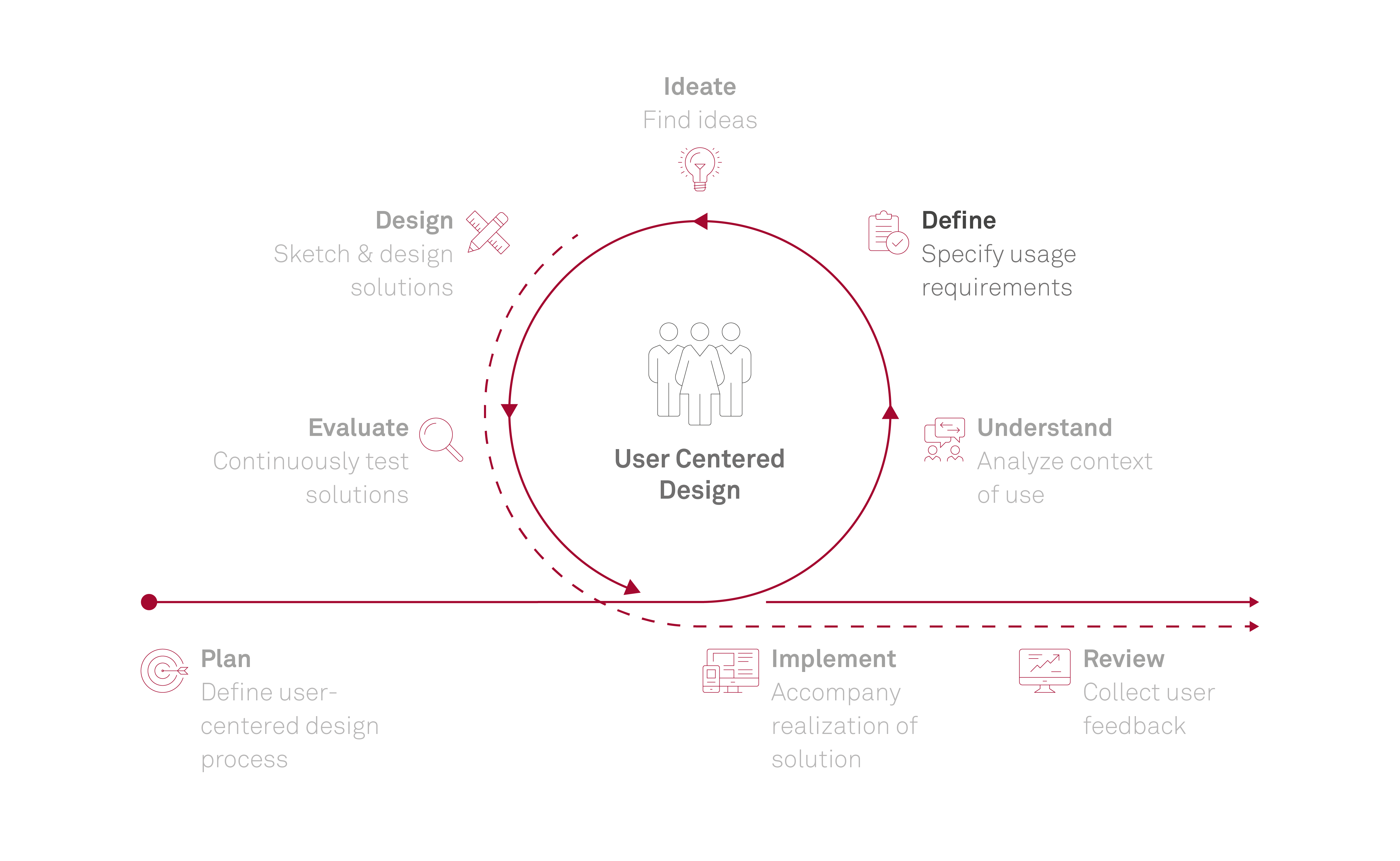
In this phase, the results from the analysis of the usage context are converted into usage requirements and prepared for the further process. In the design phase, the artifacts (e.g. personas) that are created serve as a basis for design decisions. The evaluation checks whether the application meets the specified usage requirements.
TL;DR - AI in this phase: AI helps condense data, generate persona and journey variants, and reveal inconsistencies - but synthesis itself remains a human task. Results are hypotheses, should be validated promptly by the person who collected the data, and must be traceable to concrete quotes.
# Result
A detailed overview of the requirements for the system to be developed from the user's point of view, taking different user groups into account.
# Questions to be answered in this phase
What requirements do the users have for the system to be developed?
# Benefits & use cases of AI
# Structuring and condensing data
- AI summarises results from the Understand phase and makes larger data volumes easier to handle.
- It detects and groups patterns in qualitative and quantitative data.
- It combines different perspectives from user research, usage data and domain requirements, making tensions, relationships or contradictions visible.
- Data-driven personas and user journeys can be derived and continuously refined through algorithmic analysis of larger datasets.
- Automated analysis can help define user journey categories more precisely and elaborate user journeys in greater detail.
# Generating perspectives and variants
- AI highlights alternative interpretations and structures of the same findings.
- On this basis, initial hypotheses can be derived as a starting point for design decisions.
- Persona and user journey templates can be generated quickly and provide a starting point for the team's own work.
- Persona variants with different segmentation logics or usage contexts support conscious selection and prioritisation in the team.
- Developments over time can be tracked and future usage scenarios can be anticipated.
# Making static artifacts more dynamic
- Personas can become more interactive through approaches such as "chatting" with them or simulations of typical daily situations ("day in the life"), making different perspectives and contexts more tangible.
- User journey maps can be updated dynamically as new data becomes available.
# Prioritising and ensuring consistency
- AI weights key pain points, patterns or requirements and makes them easier to compare.
- It identifies inconsistencies between artifacts such as personas, findings and user journeys, contributing to quality assurance and consistency.
# Risks of using AI
# Misinterpretation and deceptive clarity
- Synthesising findings is a cognitive and interpretive activity. If it is reduced to confirming AI suggestions, an essential learning and understanding process is lost.
- Ambiguous wording or context-dependent statements can be misclassified, leading to faulty clusters, distorted patterns or misleading insights.
- AI-suggested structures and patterns can create a deceptive sense of clarity or consensus, even when the underlying data is ambiguous, contradictory or incomplete.
- During hypothesis building, there is a risk that AI responses become overly agreeable and therefore produce a distorted picture (sycophancy).
- Premature conclusions can be drawn from AI-generated suggestions such as value propositions without sufficiently deriving them from real data and observations.
- AI-generated artifacts such as personas or user journeys can appear consistent and convincing without being sufficiently grounded in real data, and may then be mistakenly used as a valid basis in later steps.
# Bias in personas and prioritisation
- In prioritisation, AI tends to weight frequently mentioned or clearly phrased statements more strongly, while rare, implicit or context-dependent needs receive less attention.
- Generated personas may show limited diversity or reproduce existing prejudices, stereotypes and simplified representations, resulting in a distorted picture of the target group.
# Black box and disconnect from the team
- The derivation of patterns, clusters or prioritisation by AI is not transparent (black box). This makes it harder to explain, verify or defend results to stakeholders.
- If AI-generated structures and conclusions are adopted without active team synthesis, responsibility for the findings becomes unclear, making critical reflection and later justification of decisions more difficult.
# Guardrails for using AI
# Treat AI outputs as hypotheses
- AI-generated results are hypotheses or prompts for reflection, not a reliable basis or final truth.
- Responsibility for interpretation and insight generation in the Define phase remains with humans.
# Validate quickly and with the right person
- AI-supported analyses should be carried out as soon as possible after data collection. Only within that time frame can misinterpretations be reliably identified because relevant context and nuances are still present.
- AI results should be assessed and validated by the person who collected the data (for example interviewers or moderators), because implicit knowledge, situational context and non-verbal signals are crucial for correct interpretation and cannot be fully reconstructed afterwards.
# Actively require traceability
- Every AI-supported analysis step requires explicit human validation and traceable source references, especially when prioritising insights.
- Clusters and insights must be traceable to concrete quotes and sources; AI needs explicit instruction to do this.
- Compare multiple AI runs with the same data. Strong variation in outputs is an indicator of uncertainty and requires critical review.
# Sources
- Jacobsen J. (2026) Synthetic Users im Realitaets-Check (opens new window)
- Liu F., Zhang M., Budiu R. (2023) AI as a UX Assistant (opens new window)
- Lu, Y., Yang Y., Zhao Q., Zhang C., Li T.J-J. (2024) AI Assistance for UX: A Literature Review Through Human-Centered AI (opens new window)
# Note on the use of AI
Parts of this content were created using AI-supported tools, in particular M365 Copilot. The results were reviewed, revised and contextually assessed by the author. AI-generated content may be inaccurate or incomplete and was therefore not adopted without review.
Last updated 25.05.2026