
# Understand
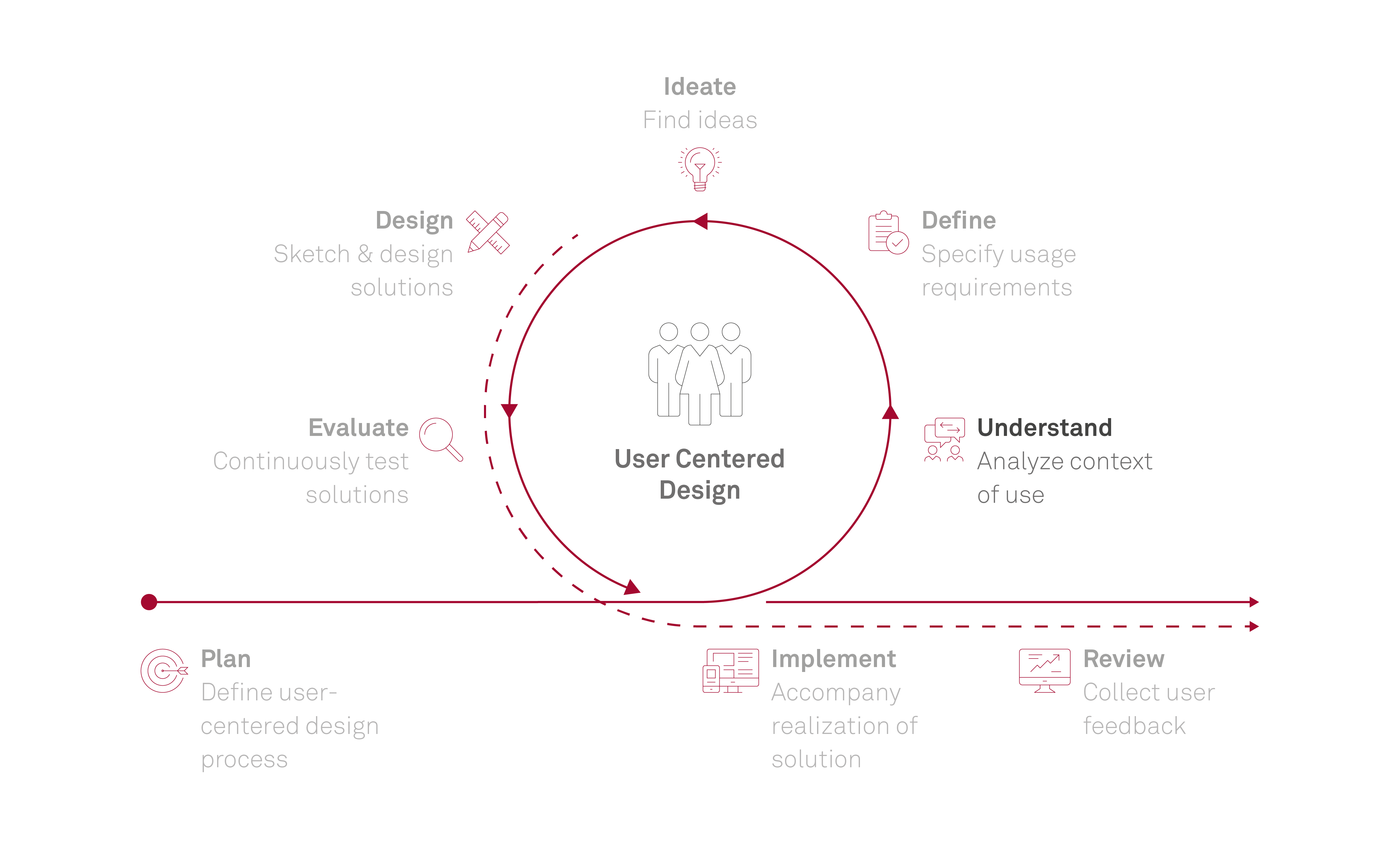
Understanding the usage context.
# Summary
This phase identifies the different user groups and their needs. The tasks, working procedures and requirements of the users are recorded and documented in a structured way. This still happens without concrete reference to the future application. In the case of a new or further development of an existing system, the existing system is also analysed in this phase in order to identify the working procedures, requirements, strengths, and weaknesses. Methods from the evaluation phase are used.
TL;DR — AI in this phase: Real user data takes priority. AI supports research, planning, execution and analysis, but does not replace professional validation or the deep contextual understanding built by UX professionals.
# Result
The result of this phase is a list of the different user groups with their working procedures and requirements for the system to be developed.
# Questions to be answered in this phase
- Who are the users?
- What do the users do?
- What problems do the users have?
- What does a user need to achieve their goal or complete their task?
# Benefits & use cases of AI
# Research & preparation
- AI supports familiarisation with specialist domains, for example by providing background knowledge or explaining technical terminology.
- Potential pain points and edge cases can be identified early.
- Initial insights into market and competitive structures can be gained.
- Relevant target groups can be defined and narrowed down, for example by deriving segmentation approaches.
# Planning research activities
- Research goals can be refined and suggestions for suitable methods, such as contextual inquiries, focus groups or diary studies, can be derived based on the research question and context.
- In the context of interviews, AI can support the full research process: from generating initial hypotheses, research questions, interview guides and plans to drafting research reports.
- AI can efficiently support the linguistic revision and refinement of these artefacts.
- AI can generate screening questions for participant recruitment, increasing the fit between the sample and the research objective.
# Execution
- AI can simulate different perspectives or usage situations, for example by playing through alternative scenarios or user reactions. This can help challenge assumptions and broaden understanding of different user types.
- In AI-moderated interviews, real people are interviewed by AI, which can be useful in structured interview settings.
- Synthetic interviews with AI-generated personas are an option when access to real users is limited or when exploratory approaches to a target group are needed.
# Analysis
- AI makes it easier to transcribe interviews and summarise conversation content.
- Text passages can be coded and analysed in a structured way.
- AI can help prepare initial insights and conclusions, but expert validation by UX professionals remains necessary.
# Connecting data sources
- Different data sources such as interviews, questionnaires, usage data or support requests can be combined and analysed together to create a more consistent overall picture of the usage context.
- Developments over time can be taken into account more easily.
- This supports a continuously updated understanding of users and their needs.
# Risks of using AI
# Bias from synthetic data
- In this phase, real user data must clearly take priority over generated data. AI-generated content must not replace real user data.
- AI-based outputs can be flawed or influenced by bias and therefore do not provide a reliable basis without further validation.
- Synthetic interviews carry the risk of overly agreeable answers, which can create a distorted picture (sycophancy).
# Distorted target group definition
- The definition of the target group itself can already be biased when supported by AI.
- Generated segmentations or screening criteria can lead to overly broad or insufficiently differentiated samples, which limits the validity of the collected data.
# Limitations of AI-moderated interviews
- The conversation usually follows the predefined script closely and reacts only to a limited extent to unexpected statements.
- Non-verbal signals that are relevant for understanding context and emotion are missing.
- The interview situation may feel unfamiliar to participants.
- Content cannot be supplemented through showing or demonstrating.
# Loss of depth of understanding
- AI does not replace the human process of building a deep understanding of users.
- A core part of UX work remains interpreting perspectives, making sense of them and understanding them in context.
- It is often useful to engage with full transcripts, for example from interviews, instead of relying exclusively on condensed AI-generated summaries.
- Continuously available AI-supported analyses can lead to individual studies being examined less deeply. Fast access to results does not replace the necessary substantive engagement with the data.
# Guardrails for using AI
# AI as support, not as a substitute
- AI should primarily be used to support research, preparation and analysis tasks. Responsibility for the quality and validity of the insights remains with UX professionals.
- The generation of data or user behaviour through AI should only be used as a supplement and must not replace real user data. UX methods should continue to be based on empirically collected data.
- AI does not replace the necessary engagement with the data, especially regarding implicit signals, nuances and situational context.
# Data protection
- Before using AI tools, it should be checked how they handle entered data, including storage, further processing and use for training.
- Sensitive or identifying information, such as participants' names, should be anonymised or pseudonymised before using AI.
# Traceability
- AI-supported analyses should always be backed by a close connection to the original data.
- Insights must be based on traceable sources, such as interview statements or observations, and must not be derived solely from aggregated or abstracted representations.
- The integration and analysis of different data sources should be transparent. Differences between sources, user groups or usage situations must remain understandable and must not be lost through overly simplified aggregation.
# Critical review
- When using AI to prepare research activities, such as method selection, target group definition or interview guides, AI suggestions should always be critically reviewed and adapted to the specific project context.
- Selecting suitable methods and designing data collection still require professional expertise and contextual knowledge.
- AI-based analyses and interim results should be treated as preliminary working outputs.
- Iterative review, adjustment and supplementation are necessary to build a robust understanding of the usage context.
# Sources
- Jacobsen J. (2026) Synthetic Users im Realitäts-Check (opens new window)
- Kohler T. (2025) 7 Deadly AI Sins for UX Professionals (opens new window)
- Liu F., Zhang M., Budiu R. (2023) AI as a UX Assistant (opens new window)
- Lu, Y., Yang Y., Zhao Q., Zhang C., Li T.J-J. (2024) AI Assistance for UX: A Literature Review Through Human-Centered AI (opens new window)
- Rosala M. (2026) AI-Moderated Interviews: If, When, and How to Use Them (opens new window)
# Note on the use of AI
Parts of this content were created using AI-supported tools, in particular M365 Copilot. The results were reviewed, revised and contextually assessed by the author. AI-generated content may be inaccurate or incomplete and was therefore not adopted without review.
Last updated 25.05.2026