
# Cores-and-Paths
- Purpose
- Identify and evaluate user goals and operator goals and derive a user-centred structure for the website.
- Time required
- 1 - 2 hours per template, about 1 day per workshop
- Participants
- 1 moderator, approx. 6 participants (project team)
- Level of experience
- Beginner
# Summary
The method was developed by Are Halland in 2007 and is used to visualise and optimise the information architecture of a website. The focus is on the most important content (cores) and user paths - not the existing structure of the website.
Instead of starting with the sitemap, the most important user needs are addressed directly. The method helps to identify and evaluate the goals of the users and the goals of the operators and to derive a user-centred structure for the website.
# Result
A clearly structured overview of:
- the most important content and functions of the website (cores),
- the paths taken by users to this content (paths),
- the possible steps the user could take after visiting a page.
This enables better coordination between user needs and operator goals and serves as a basis for the creation of wireframes and scribbles.
# Approach
- Establish the prerequisites: This includes knowledge of user needs (e.g. through user research), clear definition of business goals, overview of existing content and user tasks, alignment between user goals and operator goals.
- Organise a workshop: The method can be carried out alone or in a workshop.
- Duration: about half a day
- Number of participants: ideally 6-10 people (no more than 12)
- Materials required: Cored & Paths template, pens, post-it notes, flipchart or whiteboard
- Prioritise: The following questions should be answered:
- What are the users' most important tasks on the website?
- Where do the users‘ goals coincide with the operators’ goals?
- Which tasks are important for the operators but not essential for the users?
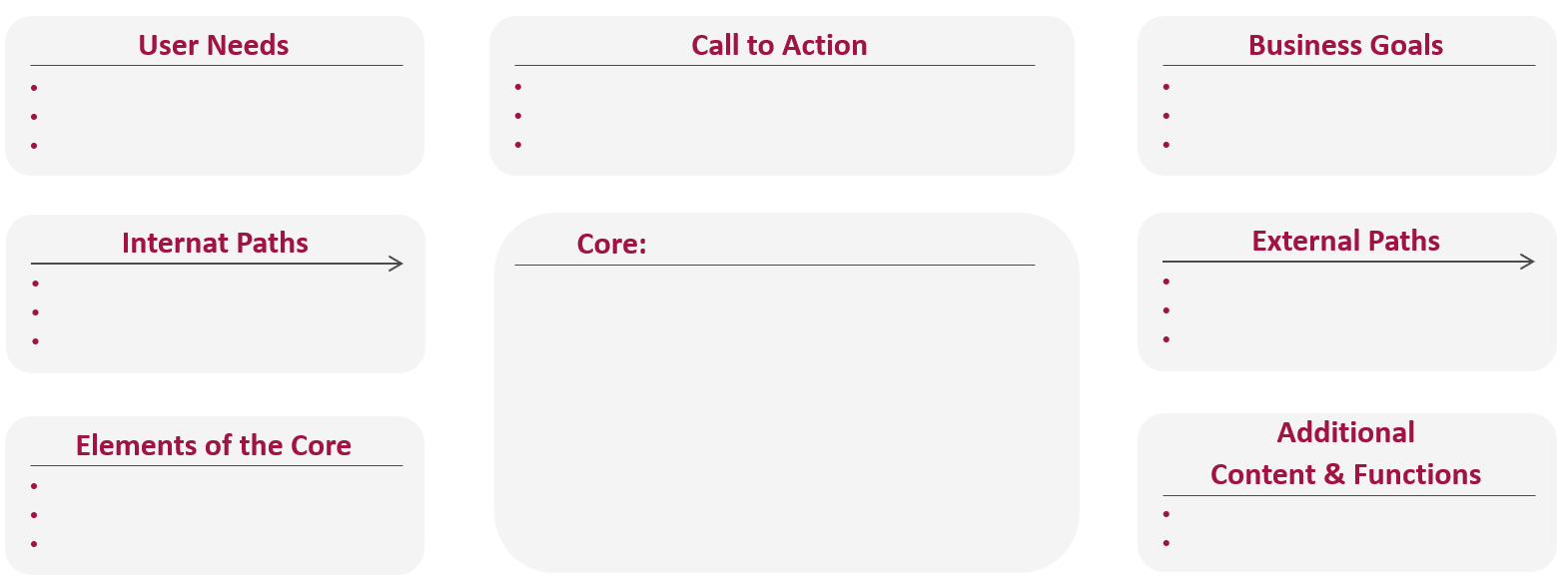
- Define the goals: For each important user task, define a page with the following information:
- Write down the title of the page/task
- Record business goals (goals of the operators)
- Define user goals
- Call to action
- The most important - the core: Define which central user need is to be fulfilled on the page. The core element is usually formulated in the form of content and functions:
- What must the site offer to fulfil the user's task?
- Which content and which functions must be available?
- The paths: define how the user arrives at the page (internal paths, e.g. Google) and how they then navigate further (external paths, e.g. related products)
- Record the results: All developed content is recorded on a core-and-path template. The completed templates form the basis for the information architecture and the creation of wireframes.
# Time of use
The cores-and-paths method is particularly suitable in the early conception phase of a website, before the creation of wireframes or prototypes.
# Tools and Templates
- template for a Cores-and-Paths analysis
- whiteboard or digital collaboration tool
- post-its and markers
- overview of business goals and user goals
# Advantages
- User-centred focus: The method concentrates on the actual needs of the users, not on the existing page structure.
- Easy to understand: Clear separation between content (cores) and paths.
- Helpful for all stakeholders: The results are easy to communicate and put into practice.
- Solid basis for wireframes: Clear definition of the most important pages and their functions.
# Disadvantages
- Requires precise knowledge of user needs: The method requires in-depth user research.
- Discussions can be lengthy: If too many stakeholders are involved, discussions could get bogged down in details.
- Time-consuming: The analysis and prioritisation of cores and paths can take several hours.
- Technical limitations: If the technical infrastructure of the website is limited, the results may not be fully realised.
# Hints
The cores-and-paths analysis should not be based on the existing page structure, but on user needs. The entry and exit paths are just as important as the content itself. The method works best with a small group. A timer can help to keep the discussions focussed and efficient.
# Sources
- Websites entwickeln mit Top-Task- & Core & Path-Analyse (German) (opens new window) (2016, Jens Jacobson)