
# Task model
- Purpose
- Overview of actions and processes
- Time required
- 30 to 60 minutes
- Participants
- User Researcher
- Level of experience
- experienced
# Summary
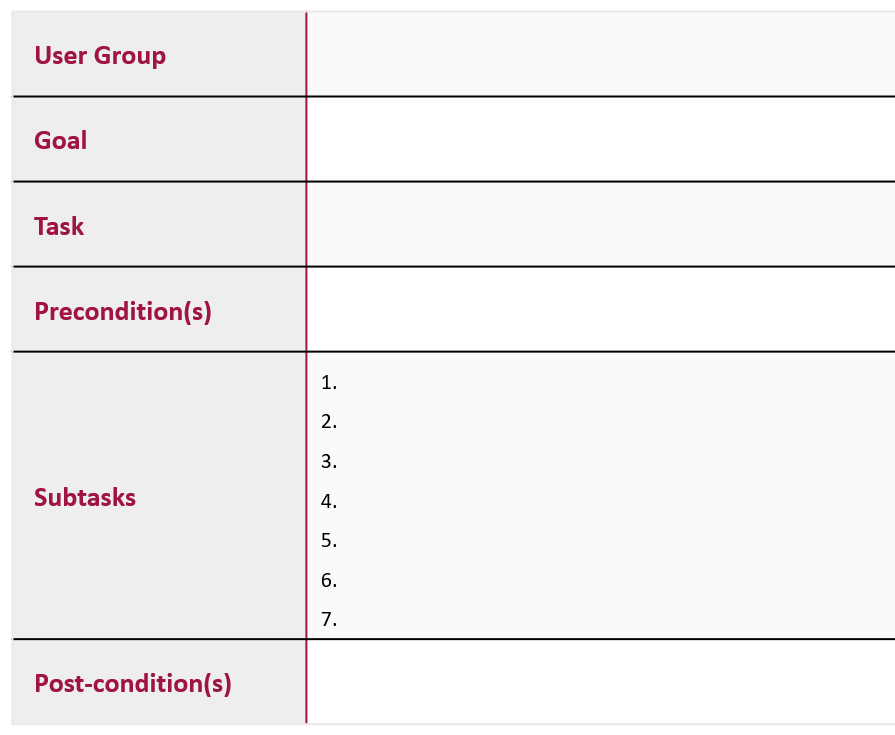
A task model describes the actions and processes that a user performs within an interactive system in order to achieve a specific goal. It focuses exclusively on the user perspective and not on the internal system processes. The model is made up of a task, several subtasks and the goal of the task. Pre- and post-conditions can also be specified.
# Result
A detailed model of the user tasks that depicts the individual steps, dependencies and possible variations of use. The result helps to better understand the context of use and to make specific improvements to the system design.
# Approach
- Select user group: The tasks are described from the perspective of a user group, not from a system perspective. Which user group or persona should be considered?
- Define goal and task: Which primary goal is the user pursuing in the system? If several goals are possible, select a specific goal. Which primary task is necessary to achieve the goal?
- Identify subtasks: The tasks of the user group are divided into smaller steps. Write a list of the subtasks. Focus on the user's actions and decisions, not on the system.
- Structure the task model: Pay attention to a correct sequence and potential dependencies between the subtasks. You can also differentiate between parallel, optional and serial processes, for example.
- Conditions: Consider whether there are preconditions or postconditions so that a user can fulfil the task and achieve the goal. Include the conditions in the model.
- Preconditions: Describe the initial situation that must be fulfilled in order for the task to be performed. (Example: The user is on the login page and has the access data)
- Post-conditions: Describe the expected situation after the task has been successfully completed (example: the user is successfully logged in and sees the dashboard).
# Time of use
A task model can refer either to the current way of working (e.g. old system) or the future interaction (new application). This means that a task model is suitable in the design phase of an interactive system in order to develop a user-friendly structure or is helpful for evaluating existing interactive systems.
# Tools and Templates
- collections of information from interviews and other research
- Personas or user group profiles
- whiteboard or digital tool (e.g. Conceptboard)
- pens and sticky notes
- template for task model
# Advantages
- User-centred focus: The model only takes into account the user's perspective and processes.
- Clarity about processes: Tasks and dependencies become visible and comprehensible.
- Identification of improvement potential: Bottlenecks and unnecessary steps can be easily recognised and eliminated.
- Communication aid: The model serves as a basis for coordination between design, development and stakeholders.
# Disadvantages
- Time-consuming for complex systems: If there are many dependencies and tasks, the model can quickly become confusing.
- No technical perspective: Since the system's perspective is excluded, relevant technical requirements may be missing.
# Hints
A task model does not replace a use case specification, but supplements it with the user perspective. If a detailed use case specification already exists, a separate task model can be omitted. In addition, the presentation should remain simple and clear to ensure comprehensibility.
# Sources
- CPUX-F Curriculum (German) (opens new window) (2023, UXQB e.V.).
- Simply usable: Usability-Modifikation - Leitfaden Nutzungsszenarios (German) (opens new window) (Jahr unbekannt, Gemeinsames Forschungsprojekt von: Fraunhofer FIT, i22 internetagentur GmbH, sunzinet AG).
- Task Analysis: Support Users in Achieving Their Goals (opens new window) (Maria Rosala, 2020).
- Hackos, J. A. T., & Redish, J. (1998). User and task analysis for interface design. New York: Wiley.
- Kirwan, B. (Ed.), Ainsworth, L. (Ed.). (1992). A guide to task analysis. London: CRC Press, https://doi.org/10.1201/b16826 (opens new window).
- Stanton, N. A. (January 01, 2006). Hierarchical task analysis: Developments, applications, and extensions. Applied Ergonomics, 37, 1, 55-79. https://doi.org/10.1016/j.apergo.2005.06.003 (opens new window).