
# Context of use description
- Purpose
- Recording the circumstances when an interactive system is used.
- Time required
- several hours to days
- Participants
- User Researcher
- Level of experience
- experienced
# Summary
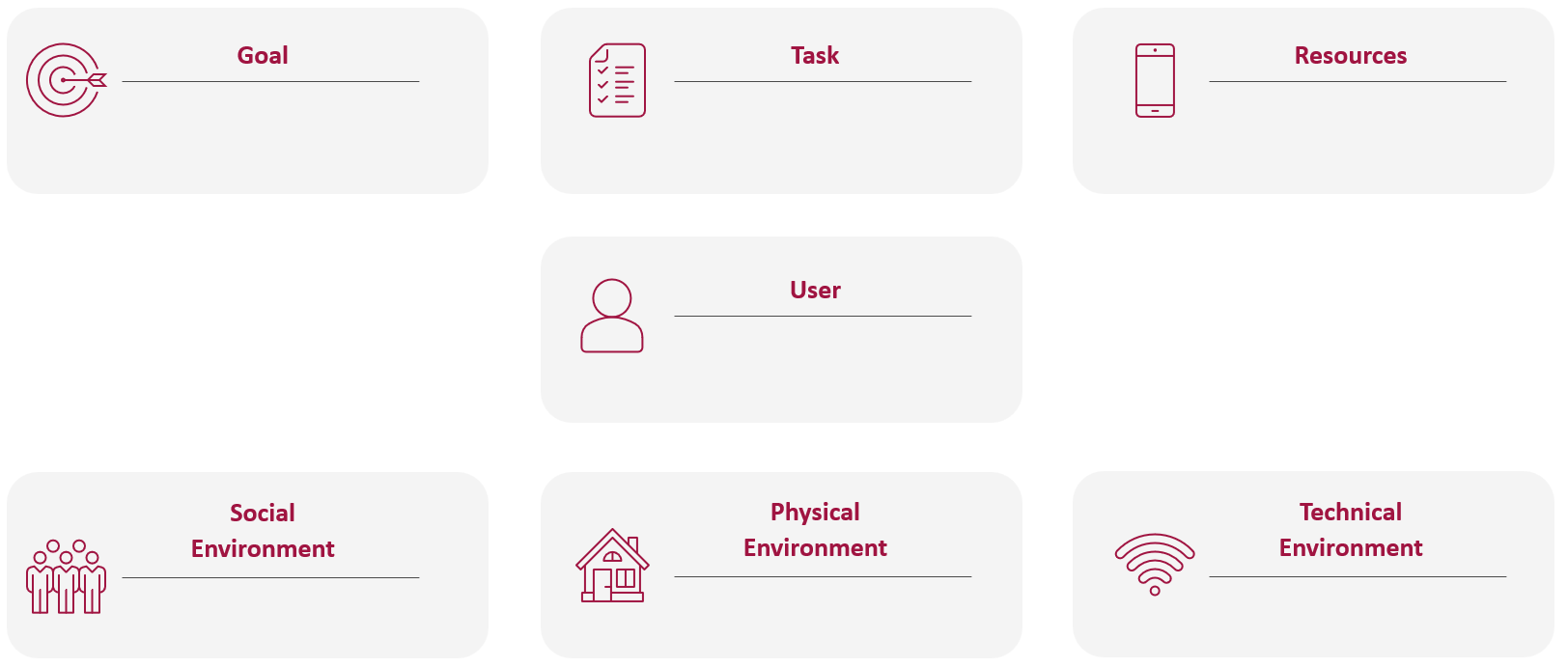
The circumstances in which the interactive system is used are recorded. This involves systematically describing the users, their goals and tasks as well as the available resources and the environment. The context of use description is based on an analysis of real usage situations, which are acquired through methods such as observations, contextual interviews, surveys or focus groups.
# Result
A structured description of the usage situation that records the users, their goals, the tasks and the conditions (resources, social, physical and technical environment). The result is the basis for deriving user requirements and designing a user-centred system.
# Approach
- Clarify the objective
- Which system or application should be analysed?
- Which user groups and usage situations should be analysed?
- Which data sources should be used to describe the context of use (e.g. interviews)?
- Describe users - Who uses the system? Information such as previous experience, technical skills, motivation and frequency of use can provide a clear picture of the user.
- Describe the goal - What do users want to achieve?
- Task - What overarching task is necessary to achieve the goal?
- Resources - What resources are available for the users? E.g. devices (e.g. laptop, smartphone) and applications (mobile app, website).
- Environment - In which environment does the use take place?
- Social environment - Are there social influences or support (e.g. colleagues, family)?
- Physical environment - Where does the use take place (e.g. office, home, on the move)?
- Technical environment - What technical conditions exist (e.g. WLAN, stable Internet connection)?
- Label assumptions: Clearly separate which information is based on concrete data (e.g. from interviews or observations) and which is based on assumptions made by the team.
- Document gaps and uncertainties: Record open questions or missing information in the model.
# Time of use
The context of use description is particularly suitable in the definition phase of a project in order to understand the conditions of use and derive user-centred requirements. It can also be helpful for preparing user tests and optimising existing systems.
# Tools and Templates
- Whiteboard or digital collaboration tool (e.g. concept board)
- Pens and sticky notes
- template for context of use description
# Advantages
- The method provides a structured and comprehensive picture of the usage situation.
- User-centred focus: The needs and conditions of the users take centre stage.
- Traceability of requirements: By linking to specific data sources (e.g. interviews), the subsequent requirements or needs can be traced back to the source.
# Disadvantages
- If assumptions are not checked, this could lead to erroneous developments.
- The collection and validation of context of use data can be time-consuming.
- The quality of the description depends on whether real user data is available.
# Hints
The context of use description not only provides a comprehensive picture of the usage situation, but also enables the requirements to be traced back to their sources (e.g. interviews, observations, focus groups and surveys). It is important to clearly separate assumptions from known information in order to avoid erroneous developments later on.
# Sources
- CPUX-F Curriculum (opens new window) (2022, UXQB e.V.)
← Task model Personas →